

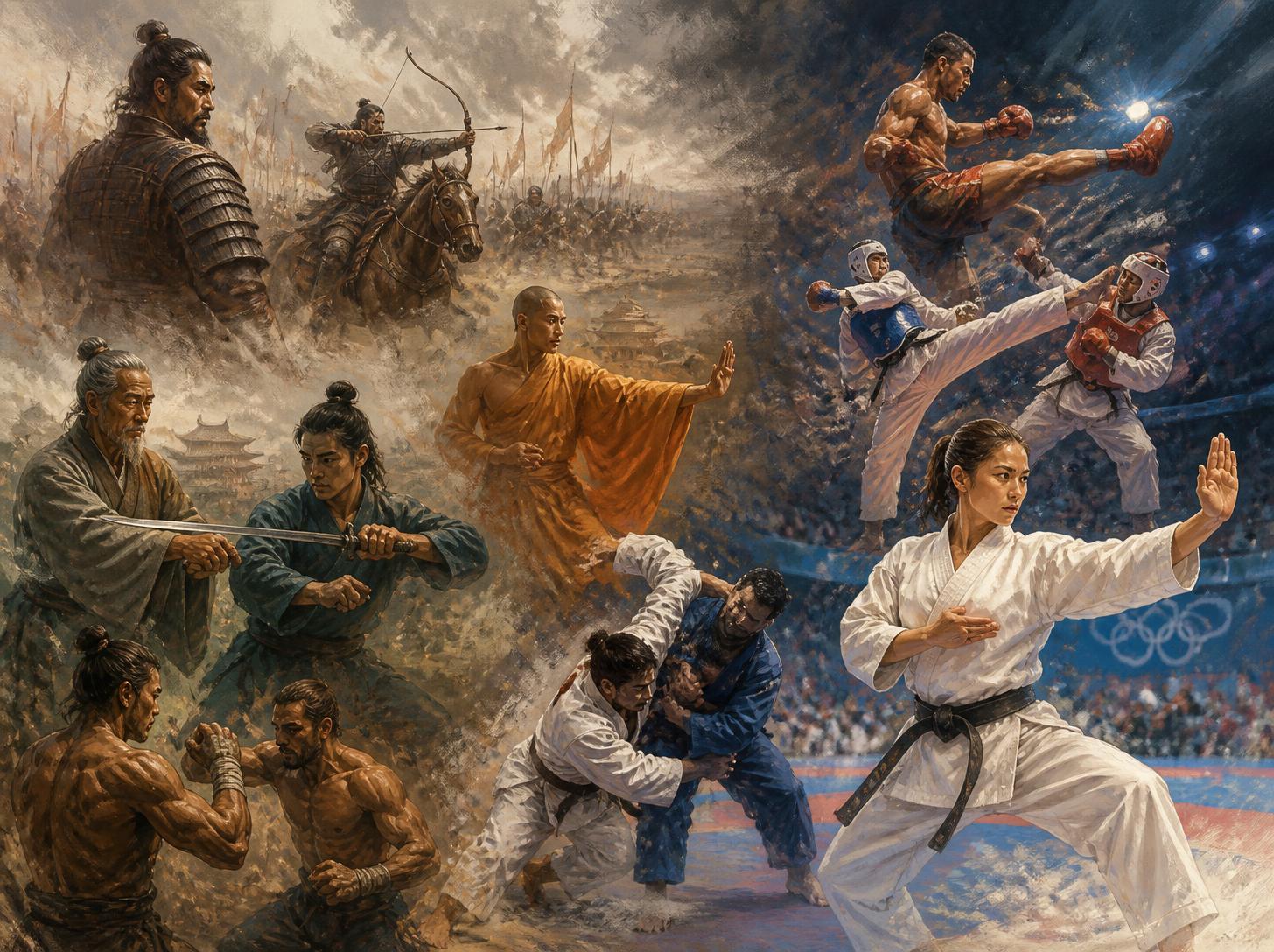
Martial arts have been an inseparable part of human civilization since ancient times, born from the basic instinct to survive. Over time, however, these raw survival skills evolved into something far richer: structured martial arts systems, steeped in philosophy, and passed down from generation to generation as markers of cultural identity. This article outlines the broad sweep of martial arts history across the world, serving as an introduction before diving deeper into the history of each individual tradition.
The Oldest Roots: From Cave Paintings to the Ancient Olympic Arena
The earliest traces of humans documenting organized combat can be traced far back in history. Archaeological and artistic evidence of organized boxing and wrestling has been found dating back to the Minoan and Mycenaean civilizations, with a cave painting in France depicting wrestlers estimated to date back to around 3000 BCE. Some sources even suggest boxing may have been practiced as far back as the sixth millennium BCE in what is now Ethiopia.
However, the most decisive turning point in the early history of world martial arts occurred in Ancient Greece. Wrestling was officially introduced to the Ancient Olympics in 708 BCE, followed by boxing in 688 BCE, and pankration — a brutal combination of boxing and wrestling with minimal rules — in 648 BCE. All three were dubbed barea athla, or “heavy events,” and became symbols of manhood, courage, and honor for the athletes who competed in them. This legacy would later become the foundation for the modern boxing and wrestling practiced around the world today.
East Asia: Temples, Philosophy, and the Birth of “Kung Fu”
On the other side of the world, China developed a martial arts tradition just as ancient, though through a very different path of development. The founding of the Shaolin Temple in 495 CE marked a crucial milestone: martial arts there developed from a fusion of Buddhist meditation and physical training, eventually giving rise to the system known to the world as Kung Fu or Wushu. The term “kung fu” itself originally had nothing to do with martial arts at all — it referred to any skill achieved through hard work — a meaning that shifted after martial arts films became popular in the West during the 1960s and 1970s.
Beginning Martial Arts Kung Fu
From China, martial arts influence spread to the Ryukyu Islands (now Okinawa, Japan), blending with local unarmed combat techniques to give rise to karate. Japan also gave birth to judo, the result of Jigoro Kano’s systematization of classical jujutsu in 1882, as well as aikido, developed by Morihei Ueshiba in the early 20th century from a blend of various jujutsu schools and his own spiritual experiences. Meanwhile, on the Korean Peninsula, ancient martial traditions such as taekkyon and subak — recorded as far back as the Three Kingdoms era — eventually merged with the influence of Japanese karate after World War II, giving rise to modern taekwondo between the 1940s and 1960s.
Southeast and South Asia: From Royal Battlefields to Spiritual Philosophy
Southeast Asia has an equally rich path of martial arts development. In Thailand, Muay Thai is believed to have originated around the 13th century during the Sukhothai Kingdom era, developing out of soldiers’ need to fight bare-handed once their weapons were lost on the battlefield — earning it the nickname “The Art of Eight Limbs” for its use of fists, elbows, knees, and shins as weapons.
In Indonesia, pencak silat developed from the hunting and warfare skills of Nusantara’s indigenous tribes as far back as around the 7th century, blending a philosophy of imitating animal movements with Hindu-Buddhist spirituality, and later Islamic influence. Silat then spread following the migration of the Malay people, giving rise to similar traditions in Malaysia, Singapore, the Philippines, and Thailand under different names.
Meanwhile, in southern India, Kalaripayattu from Kerala is often cited as one of the oldest martial arts in the world, with some accounts placing its origins thousands of years back. Some experts even believe this tradition influenced the development of Shaolin kung fu in China through the spread of wandering Buddhist monks — though this claim remains debated among historians.
The Philippines, Russia, and Modern Cultural Crossroads
In the Philippines, weapon-based martial traditions such as Kali, Eskrima, and Arnis developed out of pre-colonial communities’ need for self-defense, later adapting to Spanish colonization by disguising combat training as dance and performance art to avoid being banned by colonial authorities.
Russia gave rise to a very different path of martial arts development: Sambo, a synthesis of judo, Greco-Roman wrestling, and various folk wrestling styles from across the Soviet Union, was developed in the 1920s and 1930s by Vasili Oshchepkov and Viktor Spiridonov to meet the needs of the Red Army, before eventually evolving into a modern competitive sport.
Africa and the Americas: Martial Arts as a Form of Resistance
Across the Atlantic Ocean, capoeira was born out of the suffering of slavery in Brazil. Enslaved Africans blended combat traditions, dance, and rituals from their various cultures of origin — likely inspired by engolo, a combat dance from Angola — then disguised their martial training as dance accompanied by music, in order to avoid arousing the suspicion of slave owners. After slavery was abolished in 1888, capoeira was banned for decades before eventually being rescued and legitimized once again by Mestre Bimba in 1932.
One Instinct, a Thousand Faces
From cave paintings in Europe, the arena of the Ancient Greek Olympics, Buddhist temples in China, royal courts in Java, battlefields in Siam, to slave ships bound for Brazil — the history of martial arts around the world reveals one common thread: the human instinct for survival has always evolved into something far deeper than mere techniques of attack and defense. It becomes a cultural identity, a medium of resistance against oppression, a spiritual path, and ultimately a modern competitive sport uniting millions of practitioners worldwide through international federations and the Olympic stage.
Each martial arts tradition born in different corners of the world carries its own story — stories that will be explored in greater depth one by one in the articles that follow, beginning with the oldest roots in Asia through to the traditions that emerged most recently in the modern era.