


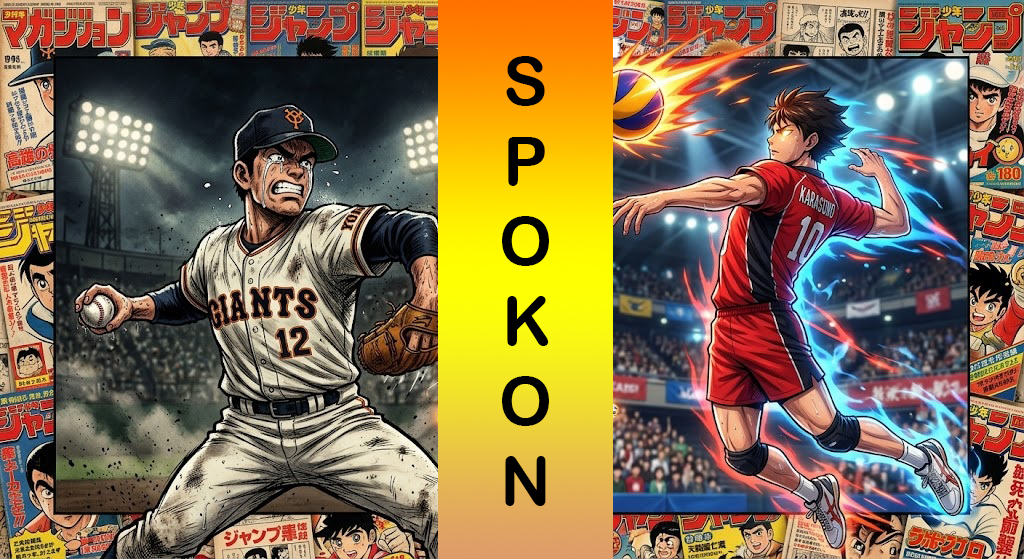
If you are a fan of sports anime like Haikyu!!, Blue Lock, or Kuroko’s Basketball, you have probably heard the term “Spokon.” It’s a genre that consistently delivers high-stakes drama, goosebump-inducing teamwork, and characters who push themselves past their absolute limits.
But have you ever wondered where the word “Spokon” actually came from? It wasn’t born from casual playground slang or internet memes. Instead, it was a brilliant marketing move cooked up by Japanese media executives in the 1960s.
Here is the untold story of how the ultimate sports anime genre was born.
The Anatomy of a Word: Sports Meets Grit
Linguistically, Spokon (スポ根) is a portmanteau—a blend of two Japanese words:
-
Sports (スポーツ – Supōtsu): Self-explanatory.
-
Konjo (根性 – Konjō): A deeply rooted Japanese concept that translates to raw grit, willpower, or guts.
Put them together, and Spokon literally means “sports driven by pure, unyielding willpower.”
The Masterstroke of 1960s Manga Magazines
The term didn’t rise organically from the public. It was engineered by journalists, manga critics, and publishers in the late 1960s to capitalize on a massive cultural shift.
Post-WWII Japan was rapidly rebuilding, and the hype reached a boiling point when the Japanese women’s volleyball team won gold at the 1964 Tokyo Olympics. They achieved this through notoriously brutal, grueling training regimens.
Sensing the public’s hunger for stories about triumph through sheer suffering, Kodansha’s Weekly Shōnen Magazine launched a baseball manga in 1966 called Star of the Giants (Kyojin no Hoshi). Unlike earlier, lighthearted sports comics, this one focused entirely on extreme physical training, pain, and konjo.
The series became an overnight sensation. To brand this new wave of high-intensity storytelling, publishers and media outlets began aggressively printing the label “Spokon Genre.” Rival magazine Weekly Margaret quickly adopted the term in 1968 for its hit volleyball manga, Attack No. 1. Through sheer media saturation, the term stuck, forever changing the vocabulary of pop culture.
From Toxic Grind to Tactical Brilliance
In the early days, classic Spokon was brutal. Characters routinely trained until they collapsed, played through career-ending injuries, and cried rivers of tears. It mirrored Japan’s post-war drive to succeed at all costs.
Fast forward to today, and the genre has evolved for a global audience. Modern hits like Haikyu!! or Ace of Diamond ditch the toxic, unrealistic self-destruction. Instead, they focus on sports science, mental health, tactics, and healthy team dynamics.
Yet, the beating heart of Spokon remains unchanged. Whether it’s a 1960s baseball pitcher or a modern-day volleyball setter, the core is always about konjo—the refusal to back down when the odds are stacked against you. What started as a clever publishing tagline 60 years ago has officially become a global blueprint for inspiration.